
 Our Experiences

Sewage treatment plants with conventional processes and advanced technologies
Remote control of purification plants
Artificial intelligence for local and remote control of purification plants
Liquid waste treatment platforms form landfill leachate and industrial liquid waste
Co-digestion of sewage sludge and OFMSW (organic fraction of municipal solid waste)
Plants for energy production
Treatment of gaseous emissions
Environmental Impact Studies (EIS) and Integrated Environmental Authorizations (EIA)
Treatment of sludge
AMBIENTE INGEGNERIA expertise is composed from 15 engineer: civil, electrical and automation, hydraulic, process and mechanical one.
AMBIENTE INGEGNERIA S.R.L. also deals its resources in the management and technical supervision of the treatment plants. The knowledge acquired in terms of process engineering ensures that IA can provide valuable assistance and supervision support. Furthermore, the experience gained in the scientific research sector of new industrial processes carried out in large treatment plants is now applied in full-scale plants to guarantee the most effective purification treatment for industrial, urban and civil waste water.
The environmental impact study (EIS) and the Integrated Environmental Authorization (EIA) are specialized reports and administrative procedures necessary in treatment plants design. IA is also organized for these activities and has gained specific experiences for medium and large size treatment plants.
Our Experiences
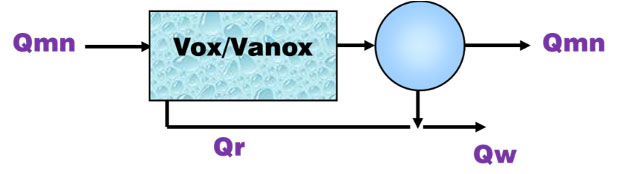
The Alternate Cycles Process (AC) is an advanced and strong technology, simple to apply and to manage the biological unit in a continuous reactor through the alternation of oxic and anoxic phases. It’s not an SBR (Sequencing) but an activated sludge process continuously feed. The process is automatically controlled in local and in remote condition on the basis of an algorithm who determine the durations of the alternating oxic and anoxic phases. The control device is intuitive and characterized by a direct approach also for the operative staff of the plants. The aeration of the bioreactor is automatically controlled through a strategy based on the control of the on-line profiles of dissolved oxygen (DO) and oxidation reduction potential (ORP). In this way, the lengths of the aerobic and anoxic phases are controlled to be just sufficient for complete nitrification and denitrification, respectively.
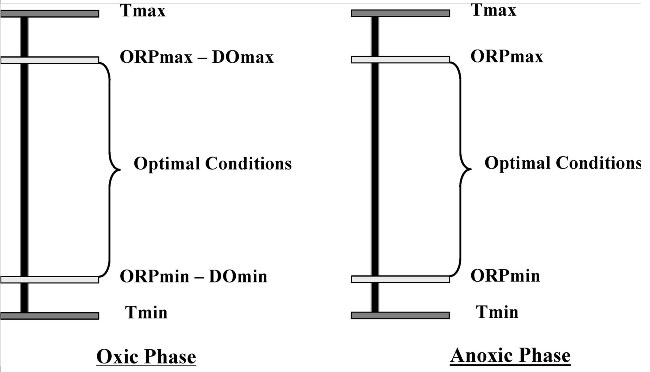
However, the ORP and DO profiles could be not reliably measured when the plant was in condition of overloading or overaeratation which can be almost common for real wastewater treatment system, especially for small treatment capacities. In these situations, in fact, the optimal conditions (OCs) could be not determined. Therefore, the complete control algorithm has been provided with a secondary safety level which are based on setpoints of the time lengths of the aerobic and anoxic phases and of the absolute values of DO or ORP (Figure 1). The reliability is tested processing the database of analogical and digital online signals by a statistical software and gives two types of information: (1) the duration of the aerobic and anoxic phases and (2) the end reason of each phase. The software allows to identify immediately the status of the process and to optimize it.